Last week, we decided to put out problem solving skills to the test with a very different and interesting challenge!
The students were placed into groups of three, and then tasked with putting up a small camping tent...WITHOUT instructions.
This was a lot of fun and quite the challenge. Some students had never put up a tent in their life, so there was (initially), a lot of discussion about what should be done first, or how each pole fitted into each sleeve. Needless to say, there were many false starts, backtracking and scratching of heads!
I am pleased to note that all groups managed to work it out in the end, and no one quit when it seemed too difficult! This was one of the key 'lessons' I wanted to get across to the students: things aren't always easy, and persistence is (by far) one of the most important traits a person can possess.
There was one group that was given an extra challenging assignment! Finn, Rosie and Fearne were all experienced campers, so knew exactly how to erect a commercially made tent. I gave them the challenge of designing and making their own survival shelter using only one tarpaulin, a length of rope and one pole. I am pleased to report they did an excellent job, and came up with a simple yet effective design. Well done!
Check out some of our photographs below!
Monday, March 26, 2018
Harmony Day 2018
Last Wednesday, our school celebrated Harmony Day, an annual event where all Australians come together and celebrate the wonderful diversity of cultures that make up this big land of ours!
All students were encouraged to dress up in a national costume, or wear orange, which is recognised as the international colour of harmony.
I was very pleased to see ALL students from Rm 22 participate in this day by donning some sort of costume. Our room was awash with beautiful dresses, brightly brocaded jackets and lots of jewellery. I particularly liked the bells worn around the ankles of some of our Indian girls...very musical!
Check out some of our photographs below!
All students were encouraged to dress up in a national costume, or wear orange, which is recognised as the international colour of harmony.
I was very pleased to see ALL students from Rm 22 participate in this day by donning some sort of costume. Our room was awash with beautiful dresses, brightly brocaded jackets and lots of jewellery. I particularly liked the bells worn around the ankles of some of our Indian girls...very musical!
Check out some of our photographs below!
Monday, March 19, 2018
STEM in Rm 22
Who said learning can't be fun?
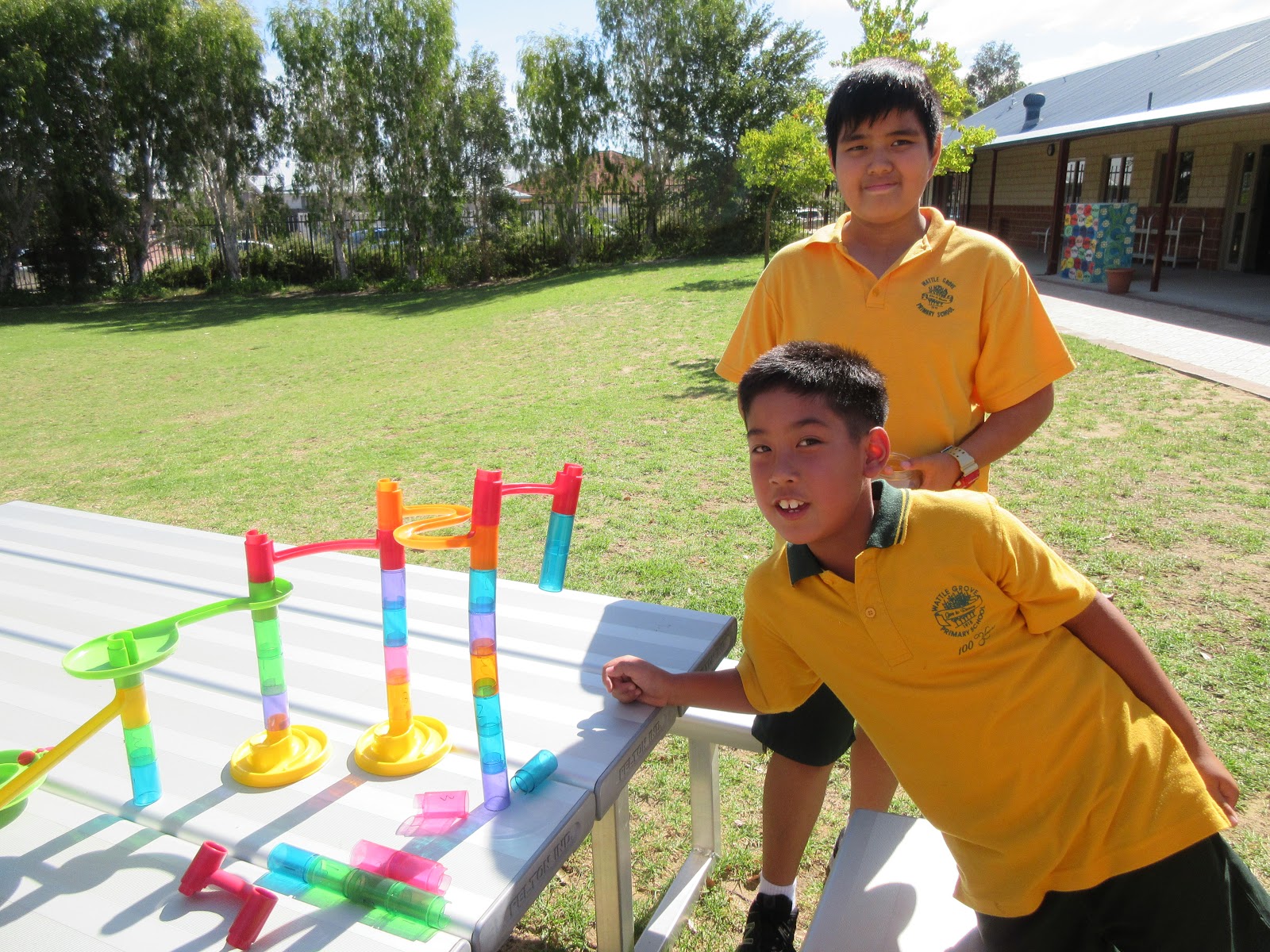
Our class had a wonderful Monday afternoon, making paper helicopters and then breaking into small groups for some engineering shenanigans!
First. we conducted some investigations into the way a paper helicopter worked. We discovered something interesting - if you change the direction of the blades to the opposite position, the helicopter will spin in the opposite direction.
Very cool!
We also tried doubling the number of blades, then shortening the 'body' of the helicopter. In each case, the efficiency of the descent was badly affected. In any case, it was a lot of fun and we felt like proper engineers, modifying and testing our creations.
For the second half of the afternoon, we split into groups and engaged in some engineering activities. We had a go at:
Our class had a wonderful Monday afternoon, making paper helicopters and then breaking into small groups for some engineering shenanigans!
First. we conducted some investigations into the way a paper helicopter worked. We discovered something interesting - if you change the direction of the blades to the opposite position, the helicopter will spin in the opposite direction.
Very cool!
We also tried doubling the number of blades, then shortening the 'body' of the helicopter. In each case, the efficiency of the descent was badly affected. In any case, it was a lot of fun and we felt like proper engineers, modifying and testing our creations.
For the second half of the afternoon, we split into groups and engaged in some engineering activities. We had a go at:
- Building long, continuous marble roll structures
- Creating circuits using our electronic kits
- Building the tallest tower possible using only playing cards
- Building vehicles and structures using Lego
- Using dominoes to build towers and pyramids
It was a fun time for all, and we look forward to engaging in more great STEM sessions!
Wednesday, February 21, 2018
Disgusting SCIENCE!
Our class has been conducting an investigation into micro organisms and it has been spectacularly revolting!
We took two slices of bread (one white and one brown) and rubbed our dirty hands thoroughly over one side of each slice. We then sprinkled some water onto the surface of the read and then locked them up inside plastic ziplock bags.
And then? We waited...for the magic to happen!
What did happen after only a few days was the appearance of moulds and various fungi. That was expected! What wasn't expected, however, was the amazing variety of different things that appeared.
There were dark green spots, thick black fur, delicate white fuzz and dark brown patches. There was even some orange and pink varieties!
The time has come to throw our little microcosms away (they are starting to smell!), but we will try to identify some of the different species that grew in Rm 22.
Check out a few of our disgusting creations.
Our class has been conducting an investigation into micro organisms and it has been spectacularly revolting!
We took two slices of bread (one white and one brown) and rubbed our dirty hands thoroughly over one side of each slice. We then sprinkled some water onto the surface of the read and then locked them up inside plastic ziplock bags.
And then? We waited...for the magic to happen!
What did happen after only a few days was the appearance of moulds and various fungi. That was expected! What wasn't expected, however, was the amazing variety of different things that appeared.
There were dark green spots, thick black fur, delicate white fuzz and dark brown patches. There was even some orange and pink varieties!
The time has come to throw our little microcosms away (they are starting to smell!), but we will try to identify some of the different species that grew in Rm 22.
Check out a few of our disgusting creations.
Thursday, February 15, 2018
Don't be so DENSE!
In Rm 22, we are always up for learning more about the world around us, and some of the physical laws that govern the universe.
This week, we have been learning about DENSITY, which is the relationship between an object's volume (the amount of space it takes up) and its MASS (which is its, er...MASS). Floating and sinking depends on the density of the medium in which you place something into, and the density of the thing you are placing! (Simple, right?)
Since water has a specific density (1.025 kg/L), an object with a lesser density will float if placed into it. If it is more dense than the water, it sinks. Incidentally - to physicists, they make no distinction between liquids and gases when it comes to floating and sinking. They sometimes refer to us as living at the bottom of an ocean of atmosphere!
Anyway, the students worked with lumps of plasticene and discovered that a lump of plasticene sinks like a rock, but if you alter its overall density by increasing the volume of the shape by making it into a boat shape, it will float. This is how battleships made from steel can float. They have a large volume, they are filled with air, and their mass is spread out over the larger volume.
The children had a lot of fun making their boats float, and then tested their carrying capacity by weighing them down with wooden blocks. Shreya and Alka managed to make a boat that carried 34 blocks! Not bad girls - maybe you should consider engineering as a future career?
In Rm 22, we are always up for learning more about the world around us, and some of the physical laws that govern the universe.
This week, we have been learning about DENSITY, which is the relationship between an object's volume (the amount of space it takes up) and its MASS (which is its, er...MASS). Floating and sinking depends on the density of the medium in which you place something into, and the density of the thing you are placing! (Simple, right?)
Since water has a specific density (1.025 kg/L), an object with a lesser density will float if placed into it. If it is more dense than the water, it sinks. Incidentally - to physicists, they make no distinction between liquids and gases when it comes to floating and sinking. They sometimes refer to us as living at the bottom of an ocean of atmosphere!
Anyway, the students worked with lumps of plasticene and discovered that a lump of plasticene sinks like a rock, but if you alter its overall density by increasing the volume of the shape by making it into a boat shape, it will float. This is how battleships made from steel can float. They have a large volume, they are filled with air, and their mass is spread out over the larger volume.
The children had a lot of fun making their boats float, and then tested their carrying capacity by weighing them down with wooden blocks. Shreya and Alka managed to make a boat that carried 34 blocks! Not bad girls - maybe you should consider engineering as a future career?
Tuesday, February 13, 2018
Oral History Project: Then and Now
As part of our HASS studies, we will be comparing and contrasting life today against life from previous generations. I think this will prove highly instructive to our children! Hopefully, it will give them a better appreciation of just how fortunate they are to be living in this time and this place.
I am asking the students to conduct an interview (or series of interviews) with either a grandparent or, if possible, a great grand parent. They will ask the interviewee questions about their childhood, and how things were different when compared to today.
This project will run over several weeks, and our MAC students will collate their information, then write it into a report, and present this in a multi media format. To this end, any photographs, letters, (etc.) would be a wonderful addition to their report (though not mandatory - it might not be possible to obtain them!).
I do understand that for many of our students, grandparents might live half way around the world, making a direct interview rather problematic. If this is the case, perhaps e-mail or even a good old fashioned letter might address these issues. Either way, I fully understand if the logistics are just too difficult to overcome, but hopefully, we can get most of the students to find a suitable source. It doesn't even have to be a blood relation - just someone who can offer insights into a life from the past! Additionally, students are welcome to interview more than one person, if they wish to get a broader range of perspectives.
The students can ask any questions they like, but here are some general lines of inquiry I would like them to explore:
As part of our HASS studies, we will be comparing and contrasting life today against life from previous generations. I think this will prove highly instructive to our children! Hopefully, it will give them a better appreciation of just how fortunate they are to be living in this time and this place.
I am asking the students to conduct an interview (or series of interviews) with either a grandparent or, if possible, a great grand parent. They will ask the interviewee questions about their childhood, and how things were different when compared to today.
This project will run over several weeks, and our MAC students will collate their information, then write it into a report, and present this in a multi media format. To this end, any photographs, letters, (etc.) would be a wonderful addition to their report (though not mandatory - it might not be possible to obtain them!).
I do understand that for many of our students, grandparents might live half way around the world, making a direct interview rather problematic. If this is the case, perhaps e-mail or even a good old fashioned letter might address these issues. Either way, I fully understand if the logistics are just too difficult to overcome, but hopefully, we can get most of the students to find a suitable source. It doesn't even have to be a blood relation - just someone who can offer insights into a life from the past! Additionally, students are welcome to interview more than one person, if they wish to get a broader range of perspectives.
The students can ask any questions they like, but here are some general lines of inquiry I would like them to explore:
- Where did you grow up? (rural, city...)
- How did your childhood home compare to the homes in 2018? (similarities, differences...)
- What were you expected to do around the home as a child?
- What toys/games/hobbies/leisure activities did you engage in as a child?
- What was parental discipline/expectations like when you were a child?
- What was a wonderful childhood memory?
- What was school like? Describe a typical classroom, day...
- Can you retell a funny/amusing incident from when you were growing up?
- Can you tell me about your first paid job? What was it? How much did it pay?
- Was there ever a time in your life when events (where you lived) were dangerous, or sad, or worrying? (wars, poverty, etc...)
- What are three things you think present day life has 'lost' from when you were growing up?
- What are three things you think present day life is better than when you were growing up?
- If you were to give one important piece of life advice to me, from all your life experience, what would it be?
We will be starting this project now and concluding it by the end of the term. If you could help the students organise the logistics of the interviews, it would be greatly appreciated. More information will follow, but the students can start the process right now.
Friday, February 9, 2018
Aussie Day Antics!
Today, our school celebrated Aussie Day. Nearly every student in the school dressed up in something related to this great land of ours and we had special assembly to show off all our Aussie spirit.
Mr Honey led the school in a wonderful rendition of 'We are Australian' and we also announced our Term One Student Representatives. Congratulations to Chelsea, Samuel and Cameron, who are our Rm 22 Reps. I know you will all do a fantastic job.
Check out some of our Aussie Day photos below!
Today, our school celebrated Aussie Day. Nearly every student in the school dressed up in something related to this great land of ours and we had special assembly to show off all our Aussie spirit.
Mr Honey led the school in a wonderful rendition of 'We are Australian' and we also announced our Term One Student Representatives. Congratulations to Chelsea, Samuel and Cameron, who are our Rm 22 Reps. I know you will all do a fantastic job.
Check out some of our Aussie Day photos below!
Subscribe to:
Posts (Atom)